 Phone: (971) 568337007
Blog
AI Predictive Maintenance for Pumps & Seals | Reduce Downtime | Qalalam

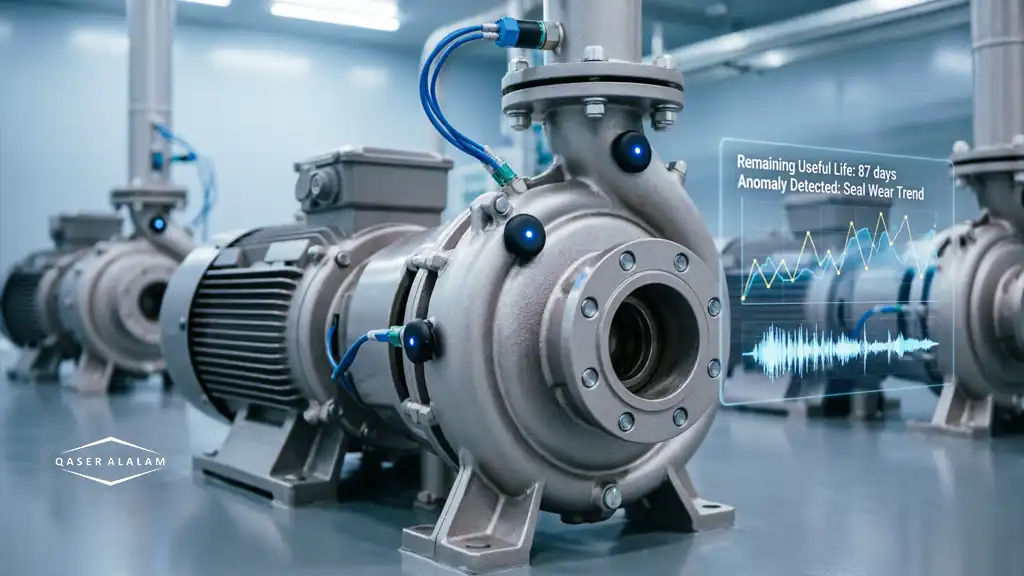
Industrial facilities depend heavily on pumps and mechanical seals to keep operations running safely and efficiently. From oil and gas refineries to chemical processing plants, power stations, and water treatment facilities, these components are at the heart of countless production systems.
Yet pump failures continue to be one of the most common causes of unplanned downtime. A damaged mechanical seal, worn bearing, cavitation issue, or alignment problem can stop production unexpectedly and lead to costly repairs.
For years, maintenance teams relied on reactive repairs or preventive maintenance schedules. While these approaches helped reduce catastrophic failures, they often resulted in unnecessary maintenance activities or missed warning signs that appeared between inspections.
Today, artificial intelligence is changing the way industrial equipment is maintained. AI-powered predictive maintenance allows companies to monitor pump health continuously, identify abnormal operating conditions, and predict potential failures before they disrupt operations.
As industries continue their digital transformation journey, predictive maintenance for industrial pumps and mechanical seals is becoming a critical strategy for improving reliability, reducing maintenance costs, and extending equipment life.
Understanding Predictive Maintenance in Modern Industry
Predictive maintenance is a maintenance strategy that uses real-time equipment data, advanced analytics, and machine learning algorithms to determine when maintenance should be performed.
Unlike traditional preventive maintenance, which follows fixed schedules, predictive maintenance focuses on the actual condition of equipment.
The goal is simple:
Perform maintenance only when necessary and before failure occurs.
For pumps and sealing systems, predictive maintenance typically analyzes:
- Vibration behavior
- Temperature trends
- Pressure changes
- Flow rate performance
- Motor current consumption
- Seal leakage levels
- Bearing condition
- Shaft movement
By continuously evaluating these parameters, AI systems can detect early signs of degradation long before operators notice visible symptoms.
Prevent costly equipment failures and unplanned downtime with high-performance sealing solutions. Explore our complete range and Buy Mechanical Seals for your application today.
Why Traditional Maintenance Strategies Are No Longer Enough
Many industrial facilities still depend on routine maintenance intervals established years ago.
For example, a pump may undergo inspection every six months, while mechanical seals are replaced annually regardless of their actual condition.
Although preventive maintenance is better than waiting for failures, it creates several challenges.
Excessive Maintenance Costs
Components are often replaced while they still have useful service life remaining.
This increases labor expenses and spare parts consumption without necessarily improving reliability.
Unexpected Failures
Equipment can develop faults shortly after a scheduled inspection.
Without continuous monitoring, these problems may remain undetected until a breakdown occurs.
Limited Visibility
Periodic inspections provide only a snapshot of equipment condition.
They cannot capture operating issues that develop between maintenance intervals.
Lost Production
Emergency shutdowns often cost significantly more than planned maintenance activities.
Production interruptions, environmental risks, and safety concerns can quickly multiply the financial impact of a failure.
These limitations are driving industries toward smarter maintenance strategies powered by artificial intelligence and Industrial IoT technologies.
Maintenance Type Cost Accuracy Downtime Risk Reactive High (Emergency) Low Very High Preventive Medium Medium Medium AI Predictive Initial Investment Very High (>90%) Minimal
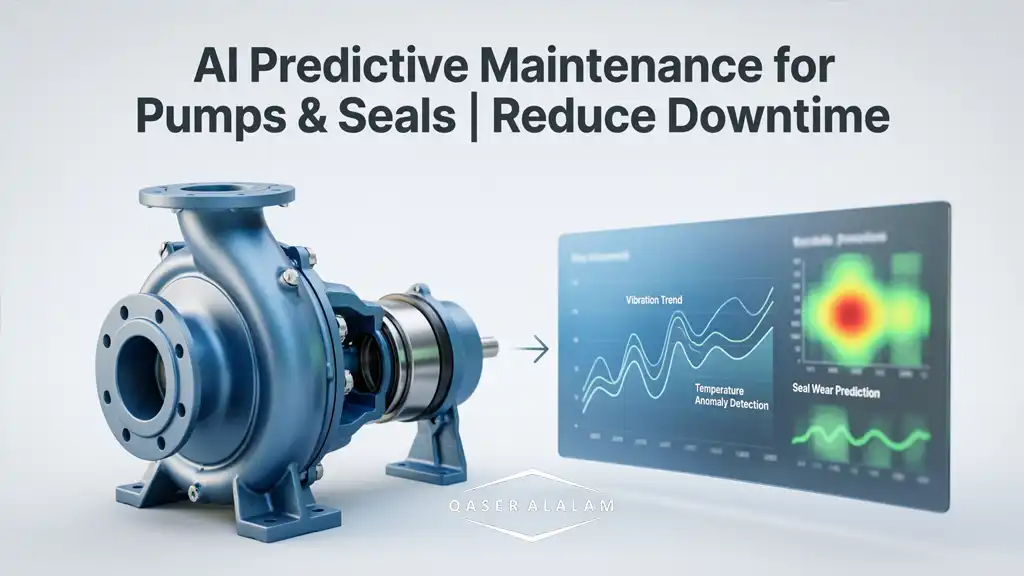
How AI-Powered Predictive Maintenance Works
AI-based maintenance systems combine multiple technologies into a single monitoring framework.
The process generally involves four key stages.
Data Collection
Sensors installed on pumps, motors, bearings, and seal systems continuously collect operational data.
Common sensor technologies include:
- Vibration sensors
- Temperature sensors
- Acoustic sensors
- Pressure transmitters
- Flow meters
- Current monitoring devices
Data Processing
The collected information is transmitted to monitoring software or cloud-based platforms.
Raw data is cleaned, organized, and prepared for analysis.
Machine Learning Analysis
Machine learning models compare current operating conditions with historical performance patterns.
The system learns what normal operation looks like and identifies deviations that may indicate emerging problems.
Predictive Alerts
When unusual patterns appear, maintenance teams receive notifications and recommendations before a failure occurs.
This proactive approach enables maintenance planning rather than emergency response.
AI Pump Monitoring Systems and Their Benefits
Modern AI pump monitoring systems provide far more than simple condition tracking.
They can analyze thousands of data points every minute and identify relationships that are impossible to detect manually.
Early Fault Detection
One of the greatest advantages of artificial intelligence is its ability to detect subtle changes.
A small increase in vibration or temperature may not trigger traditional alarms but can indicate developing equipment issues.
AI algorithms recognize these trends early and generate predictive warnings.
Reduced Downtime
When failures are predicted in advance, maintenance activities can be scheduled during planned shutdown periods.
This significantly reduces unexpected production interruptions.
Better Maintenance Planning
Maintenance teams gain visibility into future equipment needs.
Resources, spare parts, and labor can be planned more effectively.
Lower Operating Costs
By avoiding unnecessary maintenance and preventing catastrophic failures, organizations can reduce overall maintenance expenditures.
Improved Asset Reliability
Continuous monitoring allows operators to address root causes before significant damage occurs.
As a result, pumps and mechanical seals often achieve longer service life.
Understanding API 682 is essential for selecting the right sealing solution in petrochemical applications. Learn the key requirements and best practices in our Mechanical Seals: API 682 guide.
Mechanical Seal Failure Prediction Using Artificial Intelligence
Mechanical seals are among the most critical and expensive wear components in pumping systems.
Although seals are designed to operate reliably under demanding conditions, they remain vulnerable to various operating challenges.
These include:
- Dry running
- Excessive vibration
- Pressure fluctuations
- Misalignment
- Contamination
- Thermal shock
- Improper installation
Traditional maintenance methods frequently identify seal problems only after leakage becomes visible.
AI changes this approach completely.
Monitoring Seal Temperature
A rising seal temperature often indicates increased friction or lubrication issues.
Machine learning systems can recognize abnormal temperature patterns long before failure occurs.
Detecting Leakage Trends
Even minor increases in leakage can signal developing seal damage.
Predictive algorithms analyze leakage data continuously and identify changes that may otherwise go unnoticed.
Identifying Process-Related Problems
Many seal failures are caused by operating conditions rather than seal defects.
AI systems can correlate process data with equipment behavior and reveal hidden root causes.
 Read More :
BEST CHOICE: “Pump Seal Troubleshooting Guide 2026
Read More :
BEST CHOICE: “Pump Seal Troubleshooting Guide 2026
This helps maintenance teams solve problems before seals suffer significant damage.
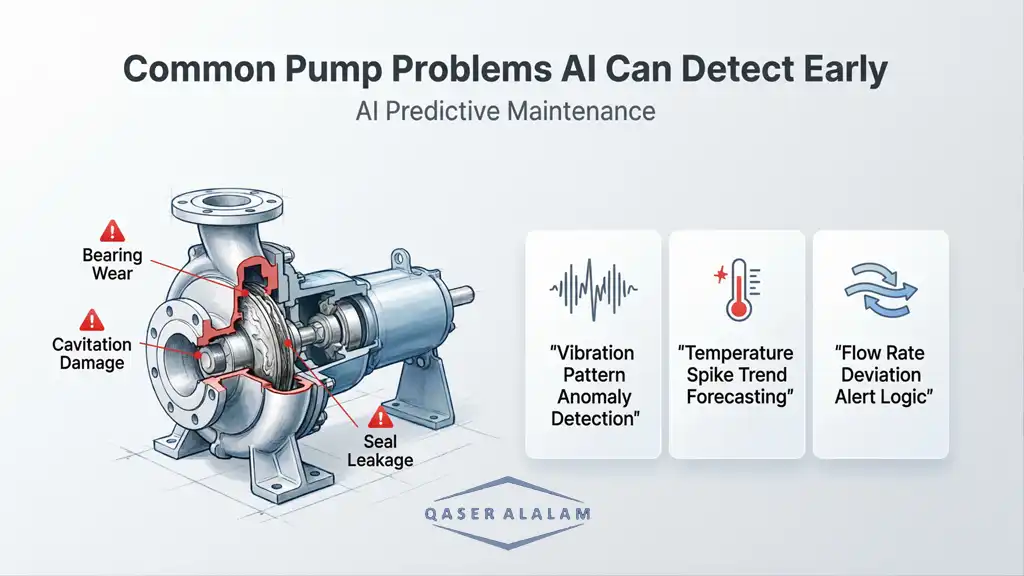
Common Pump Problems AI Can Detect Early
One reason predictive maintenance for centrifugal pumps is becoming increasingly popular is its ability to identify multiple failure modes simultaneously.
Bearing Wear
Bearings often exhibit subtle vibration changes months before failure.
AI systems can detect these patterns early and recommend inspections.
Cavitation
Cavitation remains one of the most destructive pump operating conditions.
Advanced monitoring systems identify pressure fluctuations and vibration signatures associated with cavitation damage.
Misalignment
Even small alignment errors can increase stress on seals, bearings, and shafts.
Predictive analytics can recognize alignment-related operating characteristics before excessive wear occurs.
Impeller Damage
Erosion, corrosion, and mechanical wear gradually reduce pump efficiency.
AI can identify performance losses linked to impeller deterioration.
Motor Issues
Motor current analysis provides valuable insight into equipment health.
Abnormal electrical patterns often indicate developing mechanical or electrical problems.
The Role of IIoT Sensors in Pump Condition Monitoring
Artificial intelligence depends on reliable data.
This is where Industrial Internet of Things (IIoT) sensors play a critical role.
Modern wireless monitoring devices make it easier than ever to gather real-time information from rotating equipment.
Typical sensors used for pump condition monitoring include:
- Wireless vibration sensors
- Bearing temperature sensors
- Pressure transmitters
- Acoustic emission sensors
- Flow monitoring instruments
- Motor current sensors
Because these devices collect information continuously, AI models gain a much clearer understanding of equipment behavior than traditional inspection methods.
The result is more accurate failure prediction and improved maintenance decision-making.
Predictive Maintenance in Oil and Gas Industry Applications
Few industries benefit more from predictive maintenance than oil and gas operations.
Pump failures in these facilities can lead to:
- Production losses
- Environmental incidents
- Safety hazards
- Regulatory concerns
- Expensive downtime
Many operators are now deploying AI-powered monitoring systems across critical pumping assets.
Applications include:
- Crude oil transfer pumps
- Pipeline booster pumps
- Refinery process pumps
- Injection pumps
- Chemical dosing pumps
By identifying equipment issues earlier, operators can improve reliability while reducing maintenance costs across large facilities.
Predictive Maintenance for Chemical and Petrochemical Plants
Chemical processing environments often involve aggressive fluids, elevated temperatures, and strict safety requirements.
Mechanical seal failures can create serious operational and environmental consequences.
AI-based maintenance solutions help facilities monitor:
- Seal chamber conditions
- Process temperature changes
- Pump vibration trends
- Leakage indicators
- Pressure variations
This continuous visibility enables maintenance teams to intervene before failures escalate into major incidents.
Calculating the ROI of AI-Based Pump Monitoring
One of the most common questions organizations ask is whether predictive maintenance technology justifies the investment.
The answer is increasingly yes.
Savings typically come from multiple areas.
Reduced Emergency Repairs
Emergency repairs are usually more expensive than planned maintenance activities.
Lower Spare Parts Consumption
Components are replaced according to condition rather than arbitrary schedules.
Increased Equipment Availability
Less downtime means greater production capacity and revenue generation.
Extended Asset Life
Reducing stress and operating issues helps equipment last longer.
Improved Energy Efficiency
Declining pump performance often leads to increased energy consumption.
AI systems help identify these inefficiencies early.
Many facilities recover implementation costs within the first few years through reduced maintenance and operational expenses.
The Future of Machine Learning for Mechanical Seals and Pumps
The next generation of predictive maintenance technology is already emerging.
Future systems will move beyond failure prediction and provide prescriptive recommendations.
Instead of simply saying that a pump may fail within 60 days, AI platforms will recommend specific corrective actions based on operating conditions and historical outcomes.
Additional developments include:
- Digital twin technology
- Autonomous maintenance planning
- Edge AI processing
- Real-time optimization
- Self-learning predictive models
As these technologies mature, industrial facilities will gain unprecedented control over equipment reliability and performance.
Best Practices for Implementing Predictive Maintenance Successfully
Organizations planning to adopt AI-powered predictive maintenance should follow a structured approach.
Start with Critical Assets
Focus on pumps whose failure would have the greatest operational impact.
Invest in Quality Data
Accurate sensor information is the foundation of reliable predictions.
Build Historical Data Sets
The more operational history available, the better machine learning models perform.
Integrate Maintenance Records
Combining maintenance history with sensor data improves prediction accuracy.
Train Personnel
Maintenance teams should understand how to interpret predictive insights and act on recommendations.
Conclusion
Artificial intelligence is transforming industrial maintenance by giving operators the ability to detect equipment problems long before failures occur. Through continuous monitoring, machine learning analysis, and real-time condition assessment, AI-powered predictive maintenance for pumps and mechanical seals helps organizations reduce downtime, improve reliability, and optimize maintenance spending.
As industrial facilities continue to adopt digital technologies, predictive maintenance is rapidly becoming a standard practice rather than a competitive advantage. Companies that invest in AI pump monitoring systems today will be better positioned to improve asset performance, extend equipment life, and achieve long-term operational efficiency.
For industries where reliability, safety, and productivity are essential, the future of pump maintenance is increasingly driven by intelligent data and predictive analytics.
Frequently Asked Questions about AI-Powered Predictive Maintenance
1. How much does it cost to implement AI-based predictive maintenance for pumps? While the initial investment includes IoT sensors and analytics software, most industrial facilities see a return on investment (ROI) within 12 to 18 months. This is achieved by significantly reducing unplanned downtime, lowering repair costs, and extending the lifespan of critical components like mechanical seals.
2. Can AI detect mechanical seal failure before a leak occurs? Yes. AI algorithms analyze subtle changes in vibration patterns, temperature fluctuations, and pressure data. These early warning signs often appear days or even weeks before a visible leak or catastrophic seal failure, allowing maintenance teams to act proactively.
3. What is the difference between preventive and predictive maintenance? Preventive maintenance follows a fixed schedule (e.g., every 6 months), regardless of the equipment’s actual condition. Predictive maintenance uses real-time data and AI to determine the exact health of the pump, ensuring maintenance is performed only when necessary, which optimizes resource usage and reduces unnecessary part replacements.
4. Do I need to replace my existing pumps to use AI monitoring? No. Most AI-powered predictive maintenance solutions are retrofittable. You can install non-invasive sensors (such as vibration and acoustic sensors) on your existing centrifugal or positive displacement pumps without major modifications to your current infrastructure.
5. How accurate are AI predictions for pump failures? Modern AI models trained on large datasets can achieve accuracy rates of over 90% in predicting common failure modes such as bearing wear, cavitation, and misalignment. The accuracy improves over time as the system learns the specific operational patterns of your facility.
“Need expert advice on implementing AI predictive maintenance for your pumps? Contact our engineering team today for a free consultation and find the right solution for your facility.”