 Phone: (971) 568337007
Blog
How to Select the Right Seal Material for Oil, Gas & Chemical Industries

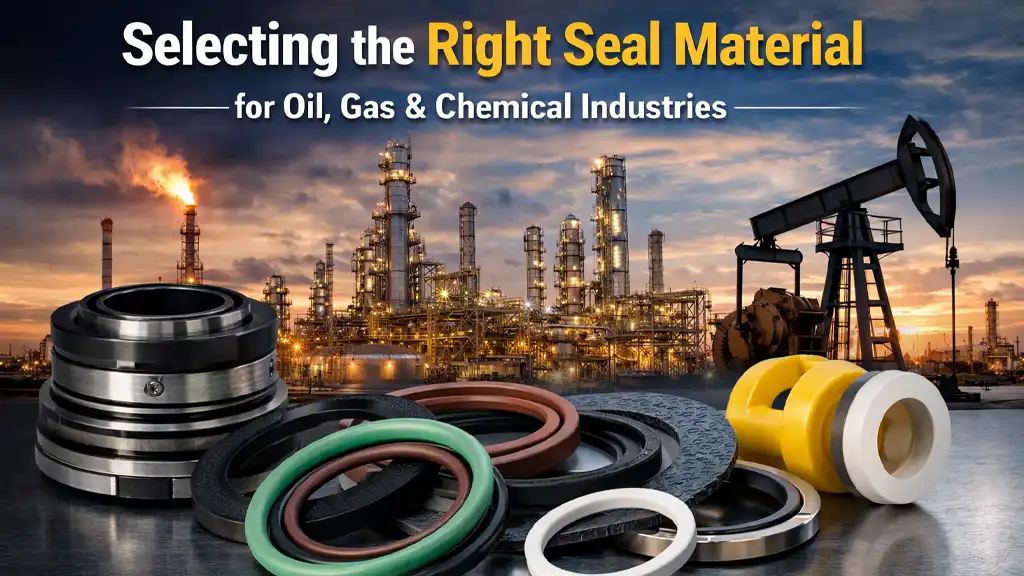
In oil, gas, and chemical operations, seal failure is almost never a minor maintenance problem. In many cases, it becomes the starting point for production interruptions, safety incidents, environmental exposure, and unplanned shutdowns that carry a high financial cost.
Although seal design often receives a lot of attention, real-world experience shows that material selection is usually the factor that determines whether a seal performs reliably over time or fails much earlier than expected.
Choosing the right seal material is not about selecting the most advanced or expensive compound on the market. What truly matters is how well the material matches the actual operating conditions, including the process fluid, operating temperature, pressure behavior, and the type of motion involved.
Why Material Selection Is Critical in Process Industries
Sealing conditions in process industries are significantly harsher than those found in standard mechanical systems. Continuous exposure to hydrocarbons, aggressive chemicals, elevated temperatures, pressure variations, and round-the-clock operation places extreme stress on sealing materials.
It is common to see a seal material perform perfectly in a hydraulic system but fail rapidly when used in a refinery pump or chemical reactor. When the material is not compatible with the environment, issues such as swelling, loss of elasticity, surface cracking, or chemical attack gradually develop, eventually leading to leakage.
For this reason, material compatibility should always be assessed before focusing on seal geometry, dimensions, or procurement cost.
Operating Conditions That Shape Seal Material Performance
Effective material selection begins with a clear understanding of real operating conditions rather than relying solely on datasheets or previous designs.
The nature of the process fluid is often the most influential factor. Oils, fuels, solvents, acids, and gases interact differently with elastomers and polymer-based materials, and even limited incompatibility can cause slow but irreversible degradation.
Temperature exposure is another decisive element. Some materials become stiff and brittle in cold environments, while others experience accelerated aging when subjected to continuous high temperatures.
Pressure levels and pressure cycling also affect long-term stability. Under high pressure, materials with insufficient mechanical strength may deform, extrude, or lose sealing contact.
In addition, the type of movement must be considered. Static joints, reciprocating motion, and rotating shafts introduce very different stresses, and not all materials respond well to dynamic conditions.
Seal Materials Commonly Used in Oil, Gas, and Chemical Plants
NBR, or nitrile rubber, is widely applied in oil and gas systems because of its reliable resistance to petroleum-based fluids. It performs well in moderate temperature ranges but is generally unsuitable for aggressive chemicals or sustained high-temperature service.
FKM materials, often known under trade names such as Viton®, are selected when higher temperatures and stronger chemical resistance are required. They are commonly used in refineries, offshore installations, and chemical processing units where thermal stability is essential.
EPDM is typically chosen for services involving water, steam, and selected chemical fluids. However, its incompatibility with oils and hydrocarbons limits its use in many oil and gas applications.
PTFE-based materials offer exceptional resistance to a wide range of chemicals and can tolerate extreme temperatures. They are frequently used in highly corrosive environments, although their low elasticity means that careful design and installation are necessary.
 Read More :
BEST CHOICE: “Pump Seal Troubleshooting Guide 2026
Read More :
BEST CHOICE: “Pump Seal Troubleshooting Guide 2026
HNBR represents an enhanced form of nitrile rubber, providing improved resistance to heat, mechanical stress, and sour gas exposure. This makes it a strong candidate for demanding oil and gas applications where standard NBR may not be sufficient.
Aligning Materials with Industry-Specific Requirements
In upstream oil and gas operations, seals are often exposed to hydrocarbons, abrasive particles, and fluctuating pressures. Under these conditions, materials such as HNBR and FKM are commonly preferred due to their durability and resistance to degradation.
Downstream refining and petrochemical facilities place greater emphasis on thermal resistance and chemical stability. FKM and PTFE-based seals are frequently used in pumps, compressors, and heat exchangers operating at elevated temperatures.
In chemical processing plants, compatibility with the process fluid becomes the dominant concern. Seal materials must withstand acids, solvents, and reactive substances without losing their physical properties. In such cases, PTFE and specialized elastomer compounds are often the safest choices.
Typical Errors in Seal Material Selection
A frequent mistake is relying on past experience without reassessing current operating conditions. Changes in fluid composition, temperature, or process severity can render a previously successful material unsuitable.
Over-specification is another common issue. Selecting premium materials where they are not technically required increases cost without providing measurable benefits.
Installation practices and surface quality are also sometimes overlooked. Even the most suitable seal material can fail prematurely if it is installed incorrectly or used on poorly finished surfaces.
Closing Perspective
Selecting seal materials for oil, gas, and chemical industries requires practical understanding rather than assumptions. Chemical compatibility, temperature exposure, pressure behavior, and motion must be evaluated together to achieve reliable performance.
When material selection is done correctly, sealing systems operate longer, leakage risks decrease, and maintenance intervals are extended. In high-risk industrial environments, proper material selection is not simply a best practice; it is a fundamental requirement.
Seal Material Comparison Table for Oil & Gas Industries
| Seal Material | Typical Temperature Range | Chemical & Fluid Resistance | Common Oil & Gas Applications | Key Advantages | Limitations |
|---|---|---|---|---|---|
| NBR (Nitrile Rubber) | -30°C to +100°C | Excellent resistance to mineral oils, fuels, and lubricants | Hydraulic systems, pumps, valves, O-rings | Cost-effective, good oil resistance, widely available | Poor resistance to high temperatures, ozone, and strong chemicals |
| HNBR (Hydrogenated NBR) | -40°C to +150°C | Very good resistance to oils, sour gas, and some chemicals | Downhole tools, compressors, high-pressure seals | Improved strength, better heat and chemical resistance than NBR | Higher cost than NBR, limited chemical compatibility |
| FKM (Viton®) | -20°C to +200°C | Excellent resistance to fuels, hydrocarbons, and many chemicals | Refinery pumps, compressors, mechanical seals | High temperature stability, long service life | Higher cost, limited low-temperature flexibility |
| EPDM | -50°C to +150°C | Excellent resistance to water, steam, and some chemicals | Steam systems, cooling circuits, water treatment | Great heat and steam resistance, good aging properties | Not compatible with oils, fuels, or hydrocarbons |
| PTFE (Teflon®) | -200°C to +260°C | Outstanding resistance to almost all chemicals | Chemical processing units, aggressive fluid systems | Exceptional chemical resistance, wide temperature range | Low elasticity, requires precise design and installation |
| FFKM (Perfluoroelastomer) | -20°C to +300°C | Near-universal chemical resistance | Critical refinery and chemical plant applications | Maximum chemical and thermal resistance | Very high cost, used only in critical services |
| PU (Polyurethane) | -40°C to +90°C | Good resistance to oils and abrasion | Hydraulic cylinders, dynamic seals | Excellent wear resistance, high mechanical strength | Limited temperature and chemical resistance |
Frequently Asked Questions (FAQ)
Which seal material is best for oil and hydrocarbon applications?
NBR and HNBR are commonly used for oil-based fluids, while FKM is preferred for higher temperatures and more aggressive hydrocarbon environments.
Are PTFE seals suitable for chemical processing plants?
Yes. PTFE offers excellent chemical resistance and is widely used in highly corrosive chemical applications, although proper design is essential.
Why do seals fail even when the correct size is used?
Seal failure is often caused by incorrect material selection, chemical incompatibility, excessive temperature, or unsuitable operating conditions rather than sizing issues.
Is FKM always better than NBR?
Not necessarily. FKM performs better at high temperatures and in aggressive environments, but NBR can be more cost-effective for moderate conditions.
How important is temperature when selecting seal materials?
Temperature is critical. Exceeding a material’s temperature limit accelerates aging, hardening, and loss of sealing performance.