 Phone: (971) 568337007
Blog
Oil Seal vs O-Ring: Key Differences in Petrochemical Applications

Why this question trips up even experienced engineers
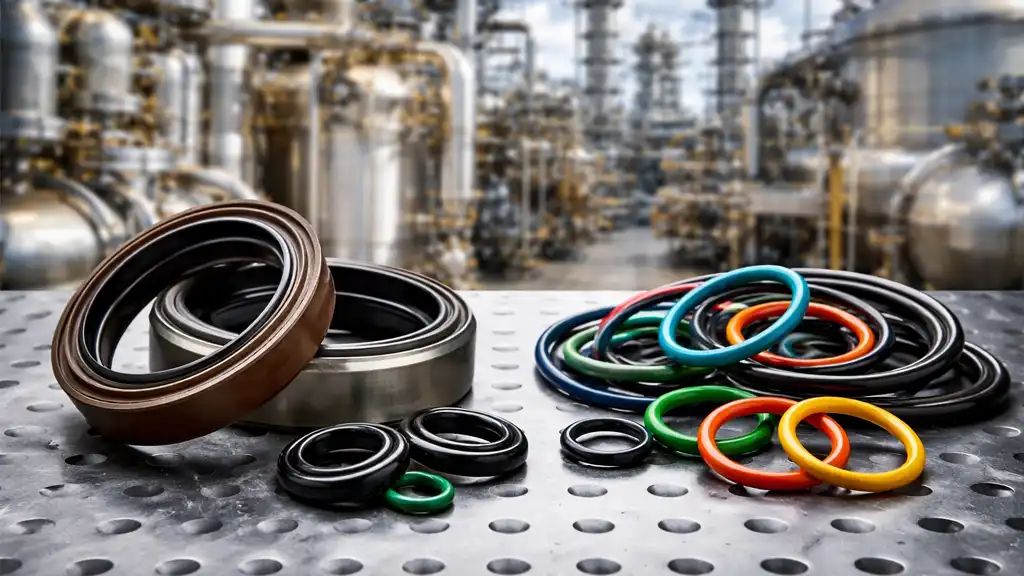
Walk into any petrochemical plant — a refinery in Ruwais, a gas processing train in Habshan, a pump skid on a FPSO — and you’ll see hundreds of seals on every piece of rotating equipment. Most of them are either an oil seal or an O-ring. They look simple. They are not.
In twenty-plus years of working with seal systems across the Middle East, we’ve seen the same mistake over and over: someone specs an O-ring where a rotary oil seal was needed (or vice versa), and the equipment fails six months later. Usually at 2 a.m. Usually on a Sunday. Usually with the fluid hitting the deck.
This guide is what we wish every new maintenance engineer had on day one. No fluff. No recycled manufacturer copy. Just the practical difference between oil seals and O-rings in petrochemical and industrial service — and a clear way to pick the right one for your application.
Oil seal vs O-ring at a glance
If you’re in a hurry, start here. The table below covers the only four things that actually matter when you’re spec’ing a seal in a real plant.
Factor Oil Seal (Rotary Shaft Seal) O-Ring Primary job Seal a rotating or oscillating shaft against a stationary housing Seal two stationary (or very slowly moving) parts against each other Motion type Dynamic — designed for continuous rotation Static (most common) or light reciprocating motion Typical locations Pump shafts, compressor shafts, gearboxes, mixers, agitators, wheel hubs Flanged joints, valve bonnets, instrumentation fittings, hydraulic cylinders, pressure vessel covers Pressure range Usually up to ~10 bar (some specialty designs go higher) Up to 400 bar in static, much lower in dynamic Temperature range (typical) -40 °C to +200 °C (material dependent) -60 °C to +200 °C standard; special compounds to +325 °C Lubrication Retains lubricant inside the housing; keeps contamination out None — relies purely on compression between mating surfaces Failure mode if misused Hard to spot — small leak becomes big leak over months Usually sudden — O-ring extrudes, swells, or chunks off Cost per piece Higher (precision part) Very low (commodity) Installation sensitivity Moderate — needs the right tool and a clean shaft High — a scratch on the groove, a nick from a pick, and it leaks
If you remember nothing else from this article, remember this: oil seals are for moving shafts. O-rings are for everything else.
«To explore our full range of standard and custom O-rings available in NBR, FKM, and EPDM, see our O-ring product series.»
What an oil seal actually does (and what it can’t do)
An oil seal — sometimes called a rotary shaft seal, a lip seal, or simply a “radial seal” — is a precision component. Its job is to keep lubricant inside a housing (an oil sump, a gearbox, a bearing cavity) while keeping dirt, water, and process contaminants out.
It does this with a flexible elastomeric lip, usually pressed against the shaft by a small garter spring. That lip follows the shaft as it rotates at speed, accommodating minor misalignment, shaft run-out, and thermal expansion.
In a petrochemical plant, you’ll find oil seals in:
- Centrifugal pumps — protecting bearing housings on the inboard end of the shaft
- Process gas compressors — sealing lube oil systems and sometimes the dry gas barrier
- Gearboxes and gear reducers — on input and output shafts
- Top-entry and side-entry mixers — sealing the agitator shaft as it enters the vessel
- Cooling tower fans, blowers, and motor shafts
Where oil seals get misused:
- In a static flange — there’s no rotation, so the lip just sits there. A gasket or O-ring is cheaper and more reliable.
- In a high-speed spindle running dry — the lip will burn up in hours without lubricant.
- In abrasive slurry service — the lip wears fast because particles get trapped against the shaft.
The honest truth: an oil seal is a lubricated dynamic seal. Treat it like anything else, and it will fail.
What an O-ring actually does (and what it can’t do)
An O-ring is the most versatile seal ever invented. It’s a doughnut-shaped piece of elastomer. You squeeze it between two surfaces, and the elastic deformation creates a near-perfect static seal.
Because of that simplicity, O-rings are everywhere. In a typical petrochemical plant, an O-ring outnumbers every other seal type by about 50 to 1.
You’ll find O-rings in:
- Flanged piping connections — especially in ANSI B16.5 / B16.47 flanges rated to Class 600 and above
- Valve bonnets and valve stems — both gate valves and ball valves
- Instrumentation and control valves — every 4–20 mA positioner has at least two
- Hydraulic and pneumatic cylinders — both rod and piston seals
- Heat exchangers — in the channel covers and floating head
- Couplings, quick-connect fittings, and sample probes
Where O-rings get misused:
- On a rotating shaft at speed — the O-ring heats up, swells, and gets chewed up. This is the #1 cause of mysterious pump bearing housing leaks.
- In a gland without proper support — the O-ring extrudes into the clearance gap under pressure.
- In a chemically incompatible fluid — the wrong material can swell, shrink, or crack within days.
- With poor surface finish on the gland — anything rougher than 0.4 µm Ra will leak and abrade the O-ring.
O-rings are not “cheap oil seals.” They are a fundamentally different kind of seal. Conflating the two is how plants end up with chronic reliability issues.
Performance differences under real industrial conditions
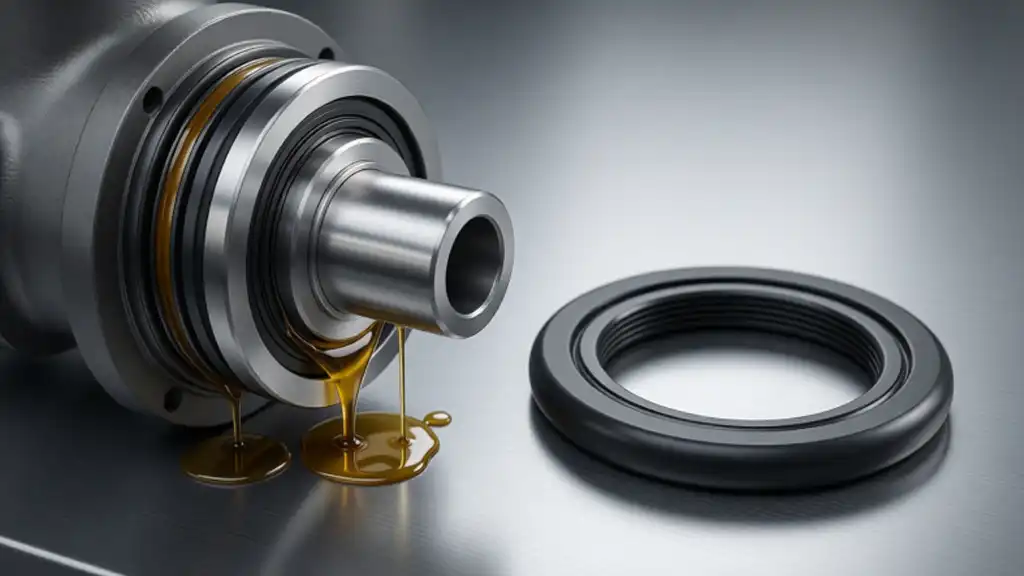
Theory is one thing. A pump running at 3,600 rpm in 80 °C hydrocarbon service is another. Here’s how the two seals actually behave in the field.
An oil seal’s whole design is built around continuous rotation. A good one can run for 5,000 to 10,000 hours before the lip starts to wear. A well-installed one in clean lube oil service can run for years.
Under rotation
An O-ring, by contrast, is not designed to rotate. Friction heats it up. The rubber softens, then wears, then tears. In a typical pump bearing housing running at 3,000 rpm, an O-ring “used as a shaft seal” will fail in days to weeks. We’ve measured surface temperatures over 120 °C in failed examples — well past the material’s continuous rating.
Under pressure
Both seals can handle pressure — but in different ways.
Oil seals rely on the lip’s radial load. Most standard lip seals are rated for differential pressures up to about 0.5 bar, with reinforced designs going to 10 bar. Above that, you step up to a mechanical seal or a specialty lip seal design.
O-rings, in static service, can handle enormous pressure — well over 400 bar in properly designed glands. That’s why high-pressure hydraulic systems and high-pressure gas cylinders are full of O-rings and almost never use oil seals.
Under temperature swing
Heat kills seals. In a petrochemical plant, ambient swings of 30+ °C between day and night are normal, and process-side temperatures can spike during startups and shutdowns.
Oil seals are typically rated -40 °C to +200 °C with FKM (Viton®) or HNBR compounds. PTFE-based lip seals can go higher.
O-rings cover a wider range: silicone for low temperatures down to -60 °C, FFKM (perfluoroelastomer) for chemical service up to +325 °C. The compound matters far more than the seal type.
Under chemical exposure
This is where petrochemical plants live or die. H₂S, hydrocarbons, aromatic solvents, amines, sour crude — each one narrows your material choices.
For oil seals, the body of the seal is usually NBR, FKM, or HNBR, with a metal insert. Chemical resistance is decent but not exceptional — they’re not the first choice for aggressive chemical service.
For O-rings, you can pick from an enormous range of compounds:
- NBR (Nitrile) — good for oils, fuels, and water; not great with aromatics or ozone
- FKM (Viton®) — excellent for hydrocarbons, acids, and high temperatures
- EPDM — best for steam, hot water, and polar solvents; not for oils
- PTFE — for the nastiest chemicals; expensive but almost chemically inert
- HNBR — a tougher nitrile for sour service and amines
- FFKM (Kalrez®, Chemraz®) — the “if nothing else works” option
A 2-line note on NACE: for sour service (H₂S > 50 ppm partial pressure), NACE MR0175 / ISO 15156 restricts which elastomers you can use. This matters. We’ve seen NBR O-rings fail in days in sour gas.
Under vibration and misalignment
Rotating equipment vibrates. Shafts drift. Foundations settle.
An oil seal’s flexible lip absorbs a surprising amount of misalignment — typically 0.5 mm to 1 mm of static shaft-to-housing offset, depending on size. Reinforced designs (the “SC” or “TC” type with a secondary dust lip) handle even more.
An O-ring has no tolerance for misalignment. If the mating surfaces shift, the gland geometry changes, and the O-ring no longer compresses uniformly. You’ll get a leak at one side of the joint and over-compression at the other.
 Read More :
BEST CHOICE: “Pump Seal Troubleshooting Guide 2026
Read More :
BEST CHOICE: “Pump Seal Troubleshooting Guide 2026
Side-by-side: which one for which job?
We’ve put this together as a quick reference. Save it. Print it. Stick it on the wall of your maintenance shop.
Application Recommended Seal Why Centrifugal pump bearing housing (rotating shaft) Oil seal (TC type, FKM) Designed for dynamic rotary service Process gas compressor bearing lube oil Oil seal (SC type, HNBR) Handles shaft movement, retains lube API 610 process pump (inboard bearing) Oil seal or labyrinth Oil seal common; labyrinth for high-speed ANSI 150–300 flange joint Spiral-wound gasket + O-ring (Class 600+) O-ring handles pressure; gasket centers load ANSI 600+ flange joint O-ring (NBR / FKM) in RTJ groove Pure static, high pressure Hydraulic cylinder piston O-ring + backup ring Static on piston, must handle high pressure Hydraulic cylinder rod O-ring + rod wiper Reciprocating; O-ring is fine, wiper protects from dirt Gate valve bonnet O-ring (NBR/FKM) Static, sized to ASME B16.34 Mixer / agitator shaft (top entry) Lip seal (cassette type) or mechanical seal Dynamic, often dry running; choose by speed and process Centrifuge shaft (high speed) Mechanical seal or specialized lip seal Oil seals not suitable above ~15 m/s Sample probe / instrumentation O-ring (small AS568 size) Static, easy to replace Cooling tower fan shaft Oil seal (TC, NBR) Dynamic, outdoor exposure Electric motor shaft Oil seal (dust lip type) Standard motor sealing practice
The rule of thumb: if it rotates faster than walking pace and runs more than a few hours a day, you almost always want a rotary oil seal or a mechanical seal — not an O-ring.
Material selection: the decision nobody wants to make but everybody pays for
We can’t tell you which material to use without knowing your process. But we can give you the framework.
Step 1: List your process fluids
Including the worst-case startup / upset condition, not just normal operation.
Step 2: List your temperature range
Both minimum and maximum. Including the case where the pump runs dry during a flush.
Step 3: List your pressure range
Both static and any pressure spikes from water hammer or thermal expansion.
Step 4: Check NACE / ISO 15156 if you have H₂S
Sour service changes everything. Some elastomers are not allowed.
Step 5: Match against a chemical compatibility chart
Parker’s O-Ring Handbook, Apple’s Compatibility Guide, Trelleborg’s seal selector — all are reputable. Always cross-check at least two sources.
Quick material cheat sheet
| Service condition | Recommended elastomer |
|---|---|
| Mineral oil, grease, general purpose | NBR (Nitrile) |
| High-temperature hydrocarbon, aromatic service | FKM (Viton®) |
| Steam, hot water, glycol | EPDM |
| Sour H₂S service (per NACE MR0175) | HNBR or FKM (low-sulfur grade) |
| Strong acids, solvents, aggressive chemicals | PTFE or FFKM |
| Food, pharmaceutical, potable water | EPDM or silicone (FDA / WRAS grade) |
| Low temperature (below -30 °C) | Silicone or low-temp FKM |
If you spec FKM as a default, you will be right 70% of the time. For the other 30%, you will be wrong in expensive ways.
Standards you should be aware of
A few standards govern oil seals and O-rings in industrial service. Your customer or EPC contractor may require compliance with one or more of these. They’re worth knowing.
- ISO 3601 — Fluid power systems, O-rings. Covers dimensions and tolerances for O-rings in hydraulic and pneumatic service.
- AS568 — The aerospace-standard O-ring size chart (in inches). Now used widely in process industries.
- DIN 3771 — European standard for O-ring dimensions. Similar to ISO 3601.
- API 682 — Pumps — Shaft sealing systems for centrifugal and rotary pumps. Defines seal chamber dimensions and seal arrangements.
- NACE MR0175 / ISO 15156 — Materials for use in H₂S-containing environments. Restricts which elastomers can be used in sour service.
- ISO 6194 — Rotary shaft lip seals. Covers dimensions, materials, and testing.
- ASTM D2000 — Standard classification system for rubber products in automotive and industrial use. Used to specify elastomer grades.
You don’t need to memorize these, but referencing the right one in your specification tells the customer you know what you’re doing.
The 60-second selection checklist
Use this when you’re spec’ing a seal and you want a sanity check before sending the PO.
For an oil seal:
- ☐ Shaft diameter (and tolerance) confirmed
- ☐ Shaft surface finish 0.2–0.4 µm Ra confirmed (or better)
- ☐ Housing bore diameter confirmed
- ☐ Material selected for fluid compatibility AND temperature
- ☐ Pressure within seal’s rating (consider stepped lip design if high)
- ☐ Dust lip added for dirty environments
- ☐ Static or dynamic? (If both, choose dual-lip or consider a different seal type)
- ☐ Installation tool on hand — no hammers, no pry bars
For an O-ring:
- ☐ Size referenced to AS568 or ISO 3601 (not “we need a 50 mm O-ring”)
- ☐ Compound selected for fluid + temperature + pressure
- ☐ Hardness matched to pressure (90 durometer for high pressure, 70 for low)
- ☐ Backup ring added for pressure > 100 bar
- ☐ Gland surface finish 0.4 µm Ra or better
- ☐ Gland clearance checked against compound / pressure chart
- ☐ Compatible with adjacent fluids (don’t mix EPDM with hydrocarbon grease)
If you can tick every box, you can be confident the seal will perform as designed.
Common failure modes (and how to spot them)
We’ve inspected thousands of failed seals. The pattern is depressingly consistent.
Oil seal failures
- Lip wear from abrasive contamination — shaft has a polished wear track, lip is hardened and cracked. Fix: improve contamination control upstream; add a dust lip.
- Chemical attack on the elastomer — lip is swollen, softened, or crumbly. Fix: change compound to FKM or PTFE.
- Shaft damage from poor installation — lip is torn in one direction. Fix: use proper installation sleeve; never pry the seal over a keyway or thread.
- Spiral failure on the shaft — helical wear pattern on the shaft surface, lip shows matching pattern. Caused by hand-finishing the shaft with a non-phenolic paper. Fix: specify shaft finish in µm, not in undefined “smooth.”
O-ring failures
- Extrusion — O-ring material squeezed into the clearance gap. Fix: reduce clearance, add a backup ring, reduce system pressure spikes.
- Compression set — O-ring no longer rebounds, looks flattened. Caused by over-compression or excessive heat. Fix: check gland depth and stretch.
- Chemical attack — O-ring swollen, cracked, or tacky. Fix: change compound.
- Spiral twist / installation damage — nicks, cuts, or twisted section. Fix: replace O-ring; check gland for sharp edges.
- Explosive decompression (ED) — internal blistering in high-pressure gas service. Fix: use ED-resistant compounds (FKM, HNBR, FFKM rated).
Knowing how a seal failed tells you almost as much as knowing why the equipment failed in the first place. Always send failed seals to a lab for analysis if the failure is repeating.
Why sourcing matters more than spec’ing
You can spec the perfect seal on paper and still get the wrong part if your supplier is cutting corners. We’ve seen:
- O-rings with substandard compound (40% ground rubber, mystery fillers) sold as “Viton®”
- Oil seals with the wrong spring tension — too tight, the lip burns; too loose, the seal leaks
- Tolerances on the metal insert out by 0.2 mm, so the seal doesn’t sit properly in the bore
- Mis-labeled material certificates (MTRs) that don’t match the actual compound
This is why we recommend sourcing from a supplier who can give you full material traceability, batch certificates on request, and an honest conversation about what they have in stock.
QASER ALALAM has been supplying sealing solutions to oil & gas, petrochemical, and water treatment operators in the UAE and wider GCC for years. Our O-ring product series covers AS568, metric, and non-standard sizes in NBR, FKM, EPDM, HNBR, silicone, and PTFE — with full material certification and a technical team that can help you spec correctly the first time.
If you need help choosing between an oil seal and an O-ring for a specific application, reach out to our engineering team. We’d rather get the spec right with you now than troubleshoot a failure later.
Conclusion: keep them in their lane
Oil seals and O-rings both stop leaks. They do it in fundamentally different ways, and they fail in fundamentally different ways when misused.
- An oil seal is a precision dynamic component. Use it on rotating shafts where you need to retain lubricant and keep contamination out. Replace it as a planned maintenance item, not an emergency.
- An O-ring is a versatile static seal (with limited dynamic capability). Use it on flanges, valves, and static glands where compression is sufficient. Size it correctly, compound it for the service, and never reuse one.
Get those two rules right and you’ll eliminate most of the chronic seal failures we see in the field.
Frequently Asked Questions
Can you use an O-ring instead of an oil seal on a rotating shaft?
In very low-speed, low-cycle applications — say a manual valve stem that turns once a day — yes, a properly compounded O-ring can work. For anything faster or more frequent, no. The O-ring will overheat, wear, and fail. Use a real oil seal, a lip seal, or a mechanical seal designed for the speed and pressure.
How long should an oil seal last in a centrifugal pump?
It depends on speed, temperature, fluid, and contamination. In clean lube oil service at moderate speed, 8,000 to 20,000 hours is a reasonable target. In dirty or hot service, you may see 2,000 to 5,000 hours. We recommend treating it as a planned replacement item during bearing change-outs rather than letting it run to failure.
Which O-ring compound is best for petrochemical service?
There’s no single answer. FKM (Viton®) is the most common default for hydrocarbon and high-temperature service. EPDM is the choice for steam and hot water. PTFE or FFKM for aggressive chemicals. Always cross-check with a chemical compatibility chart and your company’s material specifications.
Are oil seals and O-rings interchangeable in flange joints?
No. Oil seals are dynamic seals for rotating shafts; they are not designed to seal a static flange. For flanges, use a gasket (spiral-wound, compressed fiber, ring-joint) and/or an O-ring in a dedicated groove, depending on the pressure class and standard.
What causes premature seal failure in industrial systems?
In our experience, the top three causes are:
- Wrong compound for the fluid or temperature
- Installation damage (nicks, twists, over-compression)
- Using a static seal in a dynamic application (or vice versa)
All three are preventable with proper spec’ing, handling, and training.
About the author: The QASER ALALAM engineering team has been specifying and supplying industrial seals, mechanical seals, and gaskets to petrochemical, oil & gas, and water treatment operators across the UAE and the Middle East for over a decade. Contact us for technical support on your next application.
- Trelleborg Sealing Solutions → https://www.tss.trelleborg.com/
- Apple Rubber Chemical Compatibility Guide → https://www.applerubber.com/
- API 682 standard reference → https://www.api.org/standards/