 Phone: (971) 568337007
Blog
Why Do O-Rings Fail? Troubleshooting & Prevention Guide

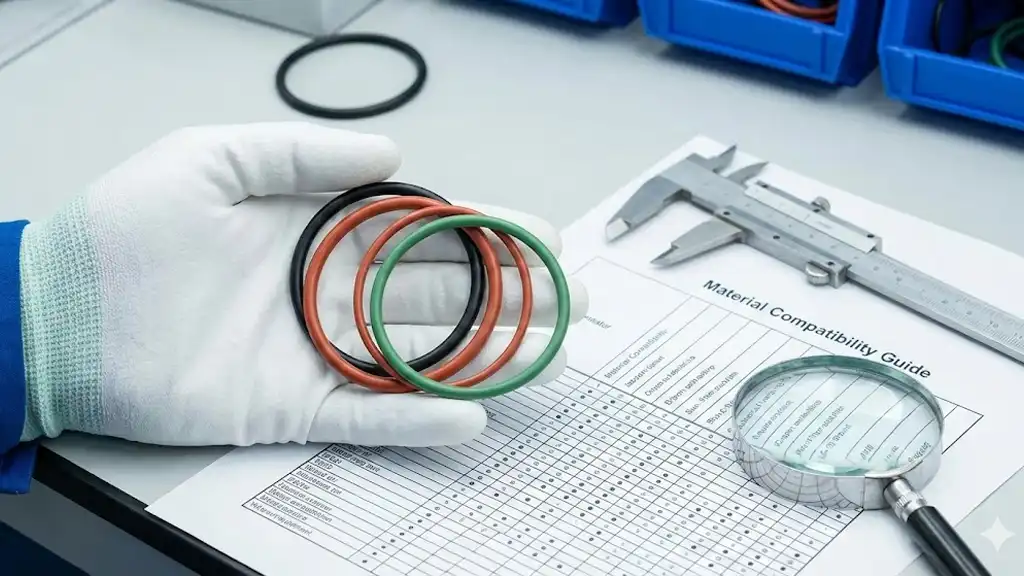
O-ring failure rarely happens without warning.
In most industrial systems, seals do not fail because they are low quality—but because they were chosen for the wrong conditions. Temperature, chemicals, pressure, and environment slowly push the material beyond its limits until leakage becomes unavoidable.
This article explains why O-rings fail in real industrial environments and how selecting the right material from the beginning can dramatically extend seal life and system reliability.
Table of Contents
The Hidden Cost of Repeated O-Ring Failure
When an O-ring fails, the cost is rarely limited to the seal itself.
Production downtime, fluid loss, equipment contamination, and emergency maintenance often follow. In many facilities, the same O-ring is replaced repeatedly—without addressing the root cause.
In most cases, failure is not caused by installation mistakes, but by material mismatch.
The Most Common Reasons O-Rings Fail Prematurely
Understanding failure modes is the first step toward prevention.
1. Chemical Incompatibility Is the Silent Killer
One of the most overlooked causes of O-ring failure is chemical attack.
When the elastomer is not compatible with the sealed fluid, the O-ring may swell, soften, or lose strength over time.
Oil-resistant materials used in water or steam systems—and vice versa—are a common source of repeated leakage.
2. Heat Slowly Destroys Elastomer Properties
High temperatures accelerate aging.
Even materials that appear stable at first may lose elasticity after prolonged exposure, leading to compression set and loss of sealing force.
Applications involving continuous heat require O-ring materials designed for long-term thermal stability, not just short-term resistance.
3. Environmental Exposure Is Often Ignored
Outdoor installations expose O-rings to UV light, ozone, and weather cycles.
Materials that perform well indoors may crack or harden rapidly when exposed to open air.
This is a frequent issue in HVAC, water treatment, and outdoor pumping systems.
4. Hardness Matters More Than Many Realize
An O-ring can fail even if the material is correct.
If the hardness (durometer) is too low, the seal may extrude under pressure. If too high, it may not conform properly to sealing surfaces.
Incorrect hardness selection is a common reason why leaks return shortly after replacement.
Choosing O-Ring Materials Based on Real Operating Conditions
Instead of selecting materials from a catalog table, successful engineers match elastomers to actual operating environments.
Nitrile (NBR): Best for Oil-Based Systems—Within Limits
Nitrile O-rings are widely used in hydraulic and fuel systems due to their excellent oil resistance and cost efficiency.
They perform reliably in moderate temperatures and controlled environments but degrade quickly when exposed to ozone, sunlight, or outdoor conditions.
NBR is often the right choice—when used in the right place.
Viton® (FKM): Designed for Heat and Chemical Exposure
When systems involve high temperatures, fuels, or aggressive chemicals, standard elastomers reach their limits quickly.
 Read More :
BEST CHOICE: “Pump Seal Troubleshooting Guide 2026
Read More :
BEST CHOICE: “Pump Seal Troubleshooting Guide 2026
Viton O-rings offer superior resistance to heat and chemical attack, making them suitable for petrochemical, processing, and high-performance industrial applications.
While more expensive, they often reduce long-term maintenance costs by lasting significantly longer.
EPDM: Ideal for Water, Steam, and Outdoor Applications
EPDM excels in environments where oil-based materials fail.
It is commonly used in water systems, steam lines, and outdoor installations due to its resistance to ozone and weathering.
However, EPDM should never be used in contact with petroleum oils or fuels.
Silicone: Flexibility Across Extreme Temperatures
Silicone O-rings are valued for their ability to remain flexible at very low and very high temperatures.
They are frequently used in clean environments such as food processing, medical devices, and electronics.
For dynamic or high-pressure applications, stronger elastomers are usually preferred.
Early Warning Signs You Chose the Wrong O-Ring Material
Most failures provide visible clues:
- Swelling: Chemical incompatibility
- Cracking: UV or ozone exposure
- Flattening: Heat-induced compression set
- Rapid wear: Incorrect hardness or dynamic use
Recognizing these signs early helps prevent repeated failures.
How to Prevent O-Ring Failure Before Installation
Effective prevention starts before the O-ring is installed:
- Identify the exact fluid or gas being sealed
- Verify continuous operating temperature—not just peak values
- Consider environmental exposure (indoor vs outdoor)
- Match material hardness to system pressure
This approach eliminates guesswork and reduces seal-related downtime.
| Failure Sign | Probable Cause | Solution |
| Flattened sides | Compression Set (High heat) | Switch to Viton (FKM) |
| Bites or chipped edges | Extrusion (High pressure) | Use Backup Rings / Harder Durometer |
| Blistering/Swelling | Chemical Incompatibility | Check Chemical Chart / Change Material |
| Cracks on surface | Ozone/UV Exposure | Switch to EPDM for outdoor use |
Frequently Asked Questions
Why do O-rings keep failing even after replacement?
Repeated failure usually indicates incorrect material or hardness selection rather than defective parts.
Which O-ring material lasts longest in harsh environments?
Viton (FKM) typically offers the best performance in high-temperature and chemically aggressive systems.
Can one O-ring material work for all applications?
No. Each elastomer is designed for specific operating conditions. Universal solutions do not exist.
Final Thoughts
O-ring reliability is not achieved by trial and error.
It is the result of matching material properties to real operating conditions.
By understanding why O-rings fail and selecting materials accordingly, industrial systems run longer, safer, and with fewer interruptions.
Instead of asking “Which O-ring should I replace it with?”
Ask “Why did the last one fail?”—the answer almost always points to the right solution.
If you are selecting O-rings for a specific industrial application, reviewing material-specific options can help prevent premature failure.
👉 Explore our range of industrial O-rings based on material and application requirements.