 Phone: (971) 568337007
 NEWSLETTER


MAGNETIC DRIVE PUMP FREE MOUNTED WITH HEATING JACKET
Contact us
Free-Mounted Magnetic Drive Pump with Heating Jacket
The Free-Mounted Magnetic Drive Pump with Heating Jacket is designed for industrial processes where reliable fluid transfer, leak prevention, and temperature control are important. Its magnetic drive system transfers power from the motor to the impeller without a conventional mechanical shaft seal, making it a suitable option for handling fluids where leakage must be minimized.
The pump casing is equipped with a heating jacket that allows heat-transfer media to circulate around the pump chamber. This arrangement helps maintain the required temperature of the pumped fluid and reduces the risk of solidification, crystallization, or excessive viscosity during operation.
The free-mounted configuration also gives engineers more flexibility when integrating the pump into an existing piping system or designing a new process line.
Magnetic Drive Design
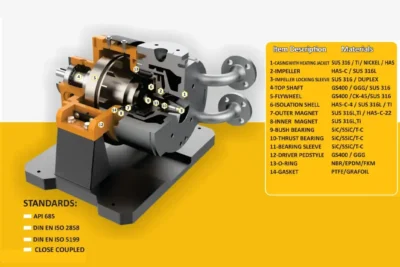
Unlike a conventional centrifugal pump that relies on a mechanical shaft seal, a magnetic drive pump uses two magnetic assemblies to transfer rotational force.
The outer magnet is connected to the motor shaft, while the inner magnet is connected to the pump impeller. A containment shell separates these components while allowing the magnetic field to transfer torque between them.
Because there is no rotating shaft passing through the pump casing, the need for a conventional mechanical seal is eliminated.
This design can be particularly valuable when pumping fluids that are corrosive, hazardous, expensive, or otherwise unsuitable for uncontrolled leakage.
Heating Jacket for Temperature-Sensitive Fluids
The heating jacket is one of the main features of this pump configuration.
Some process fluids become significantly more viscous when their temperature falls. Others may partially solidify or form crystals when exposed to lower temperatures. In these situations, simply increasing pump power is not an effective solution.
The heating jacket provides a controlled way to maintain the temperature around the pump casing. Depending on the process design, a suitable heating medium can be circulated through the jacket to keep the fluid within its required operating range.
This can help:
- Prevent unwanted solidification inside the pump
- Reduce the formation of cold spots
- Maintain more consistent fluid viscosity
- Improve startup conditions after shutdown
- Support more stable heat transfer around the pump chamber
- Reduce the risk of process interruption caused by crystallization
The jacketed casing can be especially useful when handling fluids such as molten sulfur, liquid polymers, and other temperature-sensitive process media.
Free-Mounted Configuration
The free-mounted design provides additional flexibility when positioning the pump within a process system.
Instead of relying on a large integrated base arrangement, the pump can be incorporated into the piping and equipment layout according to the requirements of the installation. This can be useful where available space is limited or where the pump needs to be positioned close to other process equipment.
The final installation should always be designed according to the pump’s hydraulic requirements, piping loads, motor arrangement, and the manufacturer’s installation recommendations.
Main Advantages
Reduced Leakage Risk
The absence of a conventional rotating shaft seal significantly reduces the potential path for process fluid to escape from the pump casing.
This is particularly important in chemical, petrochemical, and other industrial applications where even a small amount of leakage can create safety, environmental, or maintenance concerns.
Better Handling of Difficult Fluids
The heating jacket allows the pump to work with fluids whose pumping characteristics are strongly affected by temperature.
Maintaining the appropriate temperature can help keep the fluid within a more suitable viscosity range and prevent unwanted deposits or solidification inside the casing.
Lower Seal-Related Maintenance
Since the magnetic coupling replaces the conventional mechanical shaft seal, there is no mechanical seal face to replace as part of normal seal maintenance.
This can simplify maintenance planning and reduce one of the common sources of leakage in conventional centrifugal pumps.
Flexible Installation
The free-mounted arrangement gives the system designer greater freedom when incorporating the pump into process piping and equipment layouts.
This can be particularly useful for retrofit projects and industrial systems where installation space is restricted.
Suitable for Demanding Process Conditions
With the appropriate materials and configuration, this pump can be selected for applications involving corrosive chemicals, temperature-sensitive fluids, and other demanding process media.
The actual material selection should be based on the fluid composition, concentration, operating temperature, pressure, and other process conditions.
 More :
MAGNETIC DRIVE PUMP FREE MOUNTED WITH INDUCER LOW NPSHR
Typical Applications
The Free-Mounted Magnetic Drive Pump with Heating Jacket can be considered for a range of industrial processes, including:
Chemical Processing
Used for transferring chemicals where preventing external leakage is an important part of the process design. The heating jacket can also help maintain the temperature of fluids that become difficult to pump when cooled.
Petrochemical Plants
Suitable for process applications where reliable, controlled fluid transfer is required and the pumped medium must be kept within a specific temperature range.
Oil and Gas
Magnetic drive technology can be useful in applications where leakage prevention is a major consideration. The jacketed configuration can be selected for process fluids that require temperature maintenance.
Polymer and Resin Processing
Some polymers and process fluids can become highly viscous or solidify when their temperature falls. Heating the pump casing can help maintain suitable flow conditions during operation and startup.
Molten Sulfur Handling
The heating jacket can help prevent the pumped sulfur from cooling and solidifying inside the pump chamber, supporting more reliable operation.
Pharmaceutical and Process Industries
Where the process requires controlled fluid temperature and reduced risk of external leakage, a jacketed magnetic drive pump can provide an appropriate pumping solution when the materials and sanitary requirements are properly specified.
Operating Range
The pump is available for demanding operating conditions, depending on the selected model and configuration.
| Parameter | Range |
|---|---|
| Maximum Head | Up to 145 m |
| Maximum Flow Rate | Up to 350 m³/h |
| Operating Temperature | -100°C to +350°C |
| Fluid Viscosity | 0.5 to 180 cP |
| Maximum Particle Size | 0.3 mm |
| Maximum Solids Concentration | 2% by weight |
These values represent the stated operating range for the product family. The actual operating point depends on the selected pump size, impeller configuration, fluid properties, temperature, and system conditions.
Casing with Heating Jacket
The jacketed casing is designed to improve temperature control around the pump chamber.
Its main functions include:
- More uniform temperature distribution around the pumped fluid
- Reduction of cold zones inside the pump
- Lower risk of crystallization or solidification
- Efficient heat transfer around the casing
- Support for fluids with temperature-dependent flow characteristics
This feature is particularly relevant to applications involving molten sulfur, liquid polymers, and other fluids that require temperature maintenance.
Pump Size Range
The pump family is available in several sizes to accommodate different flow and head requirements.
| Pump Size | a | f | h1 | h2 | ød | l | N1 | N2 | K | G | H | M |
|---|---|---|---|---|---|---|---|---|---|---|---|---|
| 20-15-160 | 70 | 298 | 132 | 150 | 24 | 50 | 20 | 15 | 140 | 128 | 175 | M12 |
| 20-15-200 | 80 | 390 | 160 | 180 | 24 | 50 | 40 | 25 | 150 | 160 | 190 | M12 |
| 40-25-160 | 65 | 298 | 132 | 150 | 24 | 50 | 40 | 25 | 135 | 124 | 182 | M12 |
| 40-25-200 | 80 | 390 | 160 | 180 | 28 | 50 | 40 | 25 | 150 | 160 | 196 | M12 |
| 50-32-160 | 80 | 385 | 132 | 150 | 28 | 50 | 50 | 32 | 150 | 124 | 190 | M16 |
| 50-32-200 | 80 | 385 | 160 | 180 | 28 | 50 | 50 | 32 | 170 | 160 | 209 | M16 |
| 50-32-250 | 100 | 500 | 180 | 225 | 32 | 80 | 65 | 40 | 170 | 160 | 217 | M16 |
| 65-40-160 | 80 | 385 | 132 | 150 | 28 | 50 | 65 | 40 | 150 | 124 | 205 | M16 |
| 65-40-200 | 80 | 385 | 160 | 180 | 32 | 80 | 65 | 40 | 170 | 140 | 223 | M16 |
| 65-40-250 | 100 | 500 | 180 | 225 | 32 | 80 | 80 | 65 | 170 | 150 | 230 | M16 |
| 80-50-160 | 100 | 385 | 180 | 225 | 32 | 80 | 80 | 50 | 170 | 195 | 263 | M16 |
| 80-50-200 | 100 | 385 | 160 | 200 | 32 | 50 | 80 | 50 | 170 | 155 | 202 | M16 |
| 80-50-250 | 100 | 500 | 180 | 225 | 32 | 80 | 80 | 65 | 180 | 212 | 283 | M16 |
| 100-65-160 | 100 | 415 | 160 | 180 | 32 | 50 | 80 | 65 | 170 | 182 | 201 | M16 |
| 100-65-200 | 100 | 500 | 180 | 225 | 32 | 80 | 100 | 65 | 170 | 174 | 213 | M16 |
| 125-80-200 | 125 | 500 | 180 | 250 | 32 | 80 | 125 | 80 | 195 | 150 | 240 | M20 |
Choosing the Right Configuration
The correct pump size should be selected based on the required flow rate, differential head, fluid temperature, viscosity, density, vapor pressure, and system characteristics.
For fluids that are close to their solidification or crystallization temperature, the heating jacket should also be considered as part of the overall process design rather than as an optional accessory.
Material compatibility is equally important. The wetted components should be selected according to the chemical composition and operating conditions of the pumped fluid.
For a precise selection, provide the required flow rate, head, fluid type, operating temperature, viscosity, specific gravity, and available power supply.
Why Choose a Magnetic Drive Pump with Heating Jacket?
For temperature-sensitive industrial fluids, the challenge is not simply moving the liquid from one point to another. The fluid must often remain within a specific temperature and viscosity range throughout the pumping process.
Combining magnetic drive technology with a heated pump casing addresses both requirements. The magnetic coupling helps minimize the risk associated with shaft-seal leakage, while the heating jacket helps maintain suitable thermal conditions around the pump chamber.
This makes the configuration a practical option for process systems where leak prevention and temperature maintenance need to work together.
Request Pump Selection
Need help selecting the right model?
Send us your operating conditions, including flow rate, head, fluid type, temperature, viscosity, and application, and our technical team can help identify a suitable pump configuration for your process.


Reviews
There are no reviews yet.