 Phone: (971) 568337007
Blog
Double vs Single Mechanical Seals: High-Pressure Guide

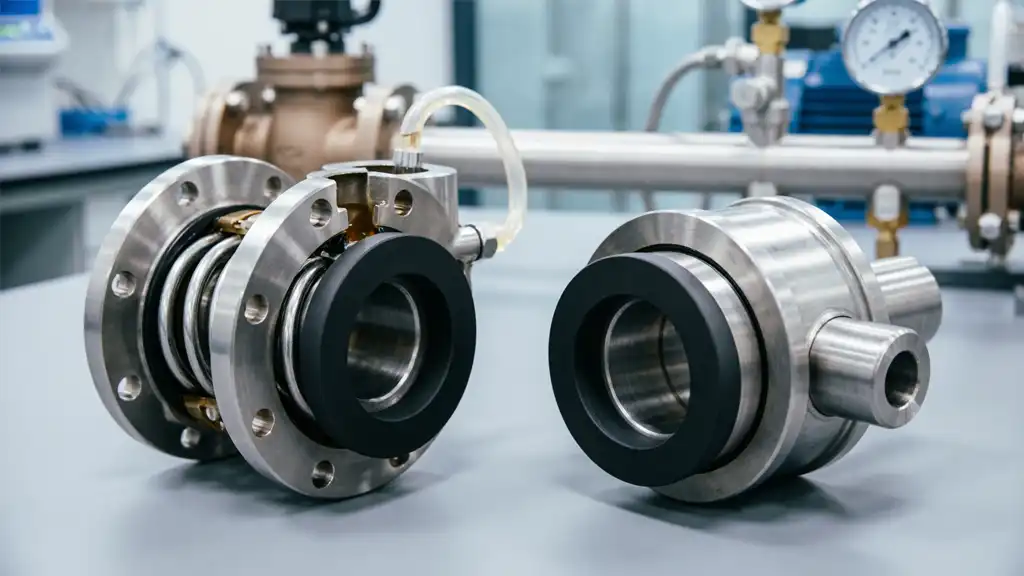
Picture this: It’s 2:00 AM on a Tuesday. Your high-pressure boiler feed pump just tripped offline. The culprit? A mechanical seal that cost less than a nice dinner for two. But the unplanned downtime? That just cost your plant fifty thousand dollars.
Sound familiar?
If you manage rotating equipment in petrochemical or industrial facilities, you already know the sheer frustration of unexpected failures. The debate over Double vs Single Mechanical Seals isn’t just an academic engineering exercise; it is a high-stakes financial decision that impacts your bottom line, safety record, and operational reliability.
Choosing the wrong seal for a high-pressure application is like buying cheap tires for a Formula 1 car. It might look fine in the parking lot, but it will fail catastrophically the second you hit the track. To make informed decisions, you must understand not just the mechanics, but also how these components fit into broader sealing strategies, including selecting the right seal material for oil, gas, and chemical industries.
Let’s break down exactly how to choose the right seal for your high-pressure systems, looking at real costs, physics, and practical applications without the excessive jargon.
The Anatomy of the Debate: Single vs. Double Mechanical Seals
Before we talk money, we need to understand the mechanics. You cannot make a smart purchasing decision if you do not understand what is actually happening inside the seal chamber. Understanding these fundamental differences is crucial when reviewing any comprehensive guide for petrochemical industries.
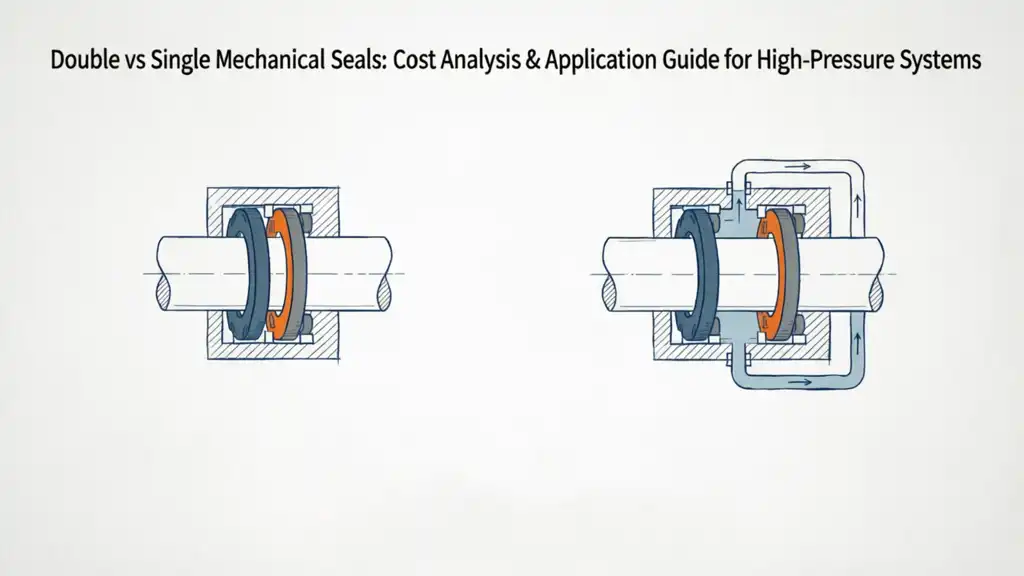
How Single Mechanical Seals Work (The Solo Act)
Think of a single mechanical seal as the front door to your house. It has one primary barrier keeping the elements out.
It consists of one rotating face and one stationary face. Springs or metal bellows push these two incredibly flat surfaces together. As the pump shaft spins, a microscopic fluid film forms between the faces. This film lubricates the seal and prevents the faces from grinding against each other.
The catch? If that single face cracks, chips, or wears out, your process fluid has a direct path to the atmosphere. There is no backup plan. While advanced mechanical seal technologies are boosting efficiency across the sector, a single seal remains a single point of failure in critical services.
How Double Mechanical Seals Work (The Dynamic Duo)
Now, imagine adding a secure vestibule to your front door. You have an outer door and an inner door. If the outer door fails, the inner door still holds.
A double mechanical seal operates on this exact principle. It features two sets of sealing faces. Between these two sets of faces is a cavity filled with a barrier fluid.
This barrier fluid is pressurized. It acts as a lubricant for the inner seal and a physical block for the process fluid. Even if the inner seal faces fail, the pressurized barrier fluid pushes back, preventing your hazardous process fluid from leaking into the environment. This redundancy is often why engineers specify doubles when preventing O-ring and seal failure is critical to safety compliance.
Pro Tip: Do not confuse “double” seals with “dual” seals. API 682 standards define dual seals as unpressurized (using a buffer fluid), while double seals are pressurized (using a barrier fluid). For high-pressure systems, you almost always want a pressurized double seal.
The Real Cost: Upfront Price Tag vs. Total Cost of Ownership
Here is where most maintenance managers get tripped up. They look at the purchase order, see that a double seal costs three times as much as a single seal, and immediately default to the single seal.
This is a classic case of being penny-wise and pound-foolish.
To make the right call, we have to look at the Total Cost of Ownership (TCO). Let’s look at the hard data derived from industry standards and field performance.
Statistical Comparison: Single vs. Double Seals
| Metric | Single Mechanical Seal | Double Mechanical Seal |
|---|---|---|
| Initial Capital Cost | $ (Baseline) | $ (2x to 3x higher) |
| Installation Complexity | Low (Standard pump glands) | High (Requires seal support system) |
| Expected MTBF (High Pressure) | 12 – 18 Months | 36 – 60+ Months |
| Environmental Leakage Risk | High (Fugitive emissions possible) | Near Zero (Contained system) |
| API 682 Category | Category 1 | Category 2 or 3 |
| 5-Year Maintenance Cost | $$ (Frequent replacements) | $ (Rare interventions) |
| Downtime Risk | High | Very Low |
[Cite source for MTBF statistics: Hydraulic Institute or similar pump reliability study]
The Hidden Costs of Going Cheap
Let’s run a quick hypothetical scenario based on typical petrochemical operations.
You have a high-pressure hydrocarbon pump running at 800 PSI. You install a single seal for $1,200. It lasts 14 months before the faces wear out and it starts leaking.
You pay for the replacement seal ($1,200). You pay for the mechanic to install it ($1,500). But the real killer is the downtime. Taking the pump offline, depressurizing the system, and bringing it back online costs you $15,000 in lost production.
Over five years, that single seal fails three times. Your total cost? Roughly $55,000+.
Now, look at the double seal. The upfront cost is $3,100. You also need a pressurized seal support system (like an API Plan 53B), which adds $12,000. Total upfront: $15,100.
But it lasts for five years without a single intervention. Zero downtime. Zero fugitive emissions. You just saved the plant nearly $40,000.
The takeaway: Never evaluate a seal based on its sticker price alone. Evaluate it based on the cost of the fluid it protects and the uptime it guarantees. This logic applies whether you are dealing with standard refinery pumps or specialized systems like hydrogen pumps powering the clean energy revolution.
High-Pressure Systems: Why the Stakes Are Higher
Running a pump at 50 PSI is one thing. Running it at 1,500 PSI is an entirely different beast. High pressure changes the physical rules of the game for mechanical seals.
Pressure Balancing and Face Loading
In a single seal, the process pressure pushes directly against the seal faces. In low-pressure applications, the springs can easily overcome this force and keep the faces closed.
But in high-pressure systems, the hydraulic force pushing the faces apart can exceed the closing force of the springs. When this happens, the faces separate. The fluid film becomes too thick. The seal starts leaking heavily.
Worse, the faces can slam back together when pressure fluctuates. This causes mechanical shock, chipping the seal faces and leading to rapid failure.
Double seals solve this elegantly. By pressurizing the barrier fluid to a pressure slightly higher than the process pressure (usually 100 to 150 PSI above), the hydraulic forces are balanced. The inner seal faces experience a net closing force, keeping them stable, lubricated, and happy regardless of process pressure spikes.
 Read More :
BEST CHOICE: “Pump Seal Troubleshooting Guide 2026
Read More :
BEST CHOICE: “Pump Seal Troubleshooting Guide 2026
The PV Limit and Heat Generation
Seal faces have a PV limit (Pressure × Velocity).
When you increase the pressure in a single seal, you increase the friction between the faces. More friction means more heat. If the heat exceeds the fluid’s vaporization point, the liquid film turns to gas.
This is called a “vaporizing fluid film.” The seal is essentially running dry. The faces overheat, crack, and shatter. It is a catastrophic failure mode that happens in seconds.
Because a double seal uses an external barrier fluid, you can choose a fluid with a much higher boiling point and better lubricity than your actual process fluid. You keep the PV limit well within safe boundaries, even if the process fluid itself is terrible for sealing. This is particularly relevant in extreme environments, such as those found in cryogenic pump sealing systems for LNG expansion.
API 682 Standards: What They Actually Mean for You
You cannot talk about mechanical seals in our industry without mentioning API 682. It is the bible for pump seals in the oil, gas, and chemical industries.
If you are dealing with high-pressure systems, you need to know which API 682 category applies to you.
- Category 1: Designed for non-hazardous processes. Pressure up to 300 PSI (20 bar). Temperature up to 400°F (200°C). Single seals live here.
- Category 2: Designed for hazardous processes. Pressure up to 300 PSI (20 bar). Temperature up to 400°F (200°C). Double or dual seals live here.
- Category 3: Designed for hazardous processes. Pressure up to 500 PSI (33 bar) or higher. Temperature up to 500°F (260°C). Double seals are mandatory here.
[Insert link to related article about API 682 4th Edition updates]
If your plant safety guidelines dictate that zero fugitive emissions are required, you are automatically pushed into Category 2 or 3. In those categories, a single seal is not just a bad idea; it is a compliance violation.
Choosing the Right Seal Flush Plan
The seal is only half the equation. The flush plan is the life support system. For high-pressure double seals, you will typically use one of the Plan 53 variants:
- Plan 53A: Pressurized barrier fluid using a bladder accumulator. Good for moderate pressures.
- Plan 53B: Pressurized barrier fluid using a piston accumulator. The gold standard for high-pressure, high-temperature applications. Provides a very stable barrier pressure.
- Plan 53C: Pressurized barrier fluid using a dual-piston setup. Used for extremely high-pressure applications where you need to maintain barrier pressure well above the process pressure.
Choosing the wrong flush plan will kill a perfectly good double seal just as fast as choosing the wrong seal type. It is also worth noting the key differences between oil seals and O-rings when designing these support systems, as secondary sealing elements play a vital role in containing the barrier fluid.
Application Guide: Which Seal Belongs in Your Pump?
Theory is great, but how do you actually apply this on the plant floor? Here is a practical guide to making the final call.
When to Stick with Single Seals
Single seals are not inherently bad. They are just highly specialized for specific conditions. You should confidently specify a single seal when:
- The fluid is clean and non-hazardous: Think clean water, condensate, or mild coolants. If it leaks, it just makes a puddle.
- The pressure is low to moderate: Generally under 250 PSI (17 bar).
- The temperature is moderate: Under 300°F (150°C).
- Budget is the absolute primary constraint: You have zero capital for a seal support system, and the cost of downtime is negligible.
Real-world example: A standard cooling water circulation pump in a power plant or a wastewater pump handling non-hazardous effluent. The fluid is clean, the pressure is low, and if the seal weeps, nobody dies. A single seal is the perfect, cost-effective choice here.
When You Absolutely Need Double Seals
Double seals are your heavy artillery. You deploy them when the environment is hostile and the consequences of failure are severe. Specify a double seal when:
- The fluid is hazardous or toxic: Hydrocarbons, H2S, acids, or caustics. Fugitive emissions are a safety and environmental nightmare.
- The fluid is abrasive or prone to crystallizing: If your process fluid contains particulates, it will act like sandpaper on single seal faces. A double seal isolates the faces from the abrasive process fluid.
- The pressure is high: Anything over 300 PSI (20 bar), but especially systems running at 1,000+ PSI.
- The fluid has poor lubricity: Liquid propane, LNG, or hot water. These fluids do not form a good lubricating film. A double seal allows you to use a highly lubricious barrier fluid instead.
Real-world example: A high-pressure crude oil export pump running at 1,200 PSI. The crude is abrasive, highly flammable, and the plant is located near a populated area. A single seal would be a massive liability. A double seal with an API Plan 53B system is non-negotiable.
Actionable Takeaways: How to Make the Right Call Today
We have covered a lot of ground. Let’s distill this down into a checklist you can use the next time you are specifying a seal for a high-pressure pump.
- Calculate the True Cost of Failure: Before rejecting a double seal based on price, calculate the cost of one unplanned shutdown. Include lost production, overtime labor, and environmental fines. The math almost always favors the double seal in critical services.
- Audit Your Fluid Properties: Do not just look at pressure and temperature. Look at the fluid’s lubricity, vapor pressure, and toxicity. If it is a poor lubricant, a double seal will save your faces from dry running.
- Invest in the Support System: A double seal without a properly sized and maintained seal support system is just an expensive single seal. Budget for the accumulator, the piping, and the instrumentation.
- Leverage Technology: Consider integrating AI-powered predictive maintenance for pumps and seals to monitor barrier fluid levels and pressure differentials in real-time, catching issues before they become failures.
- Train Your Operators: The best seal in the world will fail if your operators do not know how to monitor it. Ensure your team knows how to check barrier fluid levels and spot early warning signs.
- Standardize Where Possible: If you have fifty high-pressure pumps, do not buy fifty different seal designs. Standardize on one double seal cartridge and one support system design. This drastically reduces your spare parts inventory and simplifies maintenance.
[Insert link to related article about Mechanical Seal Failure Analysis and Troubleshooting]
Final Thoughts
The debate over Double vs Single Mechanical Seals ultimately comes down to risk management.
Single seals are the budget-friendly workhorses for clean, low-pressure, low-risk applications. They do a great job when the stakes are low.
But when you step into the world of high-pressure systems, the rules change. The hydraulic forces are higher, the temperatures are more extreme, and the consequences of a leak are catastrophic. In this environment, double seals are not just an upgrade; they are an insurance policy. They protect your equipment, your environment, and your profit margins.
Stop looking at the purchase price of a seal. Start looking at the value of the uptime it provides.
Ready to optimize your pump reliability? Take a walk around your plant today. Identify your top five high-pressure, high-risk pumps. Check their seal types and flush plans. If they are running single seals in high-pressure hydrocarbon service, you have just found your next high-ROI maintenance project.
Talk to your seal supplier, run the TCO numbers, and make the switch. Your future self (and your weekend plans) will thank you.
Frequently Asked Questions (FAQ)
Can I upgrade a single seal to a double seal without changing the pump?
In most cases, yes. Modern mechanical seals are designed as cartridge units. Upgrading usually requires modifying the pump gland plate to accommodate the larger seal cartridge and adding piping connections for the barrier fluid. However, you will also need to install an external seal support system (like an accumulator), which requires space on the skid.
What is the typical pressure limit for a single mechanical seal?
Standard single mechanical seals are generally rated for pressures up to 300 PSI (20 bar) according to API 682 Category 1 standards. While some specialized single seals can handle up to 500 PSI, they require complex pressure-balancing designs and are highly susceptible to face instability and leakage at those pressures.
How often should barrier fluid be changed in a double seal system?
The barrier fluid in a pressurized double seal system (like an API Plan 53B) does not need to be changed on a routine schedule as long as the system remains closed and pressurized. However, you should monitor the fluid condition during routine inspections. If the fluid becomes discolored, contaminated with process fluid (indicating inner seal failure), or degraded, it must be flushed and replaced immediately.
Why is my double seal leaking barrier fluid into the process?
If barrier fluid is leaking into the process, it means the outer seal faces have failed, while the inner seal faces are still intact. This is actually the designed safety mechanism of a double seal. It prevents the hazardous process fluid from escaping to the atmosphere. You need to shut down the pump and replace the seal cartridge, but the environment has been protected.